a cura della redazione
6/4/2017
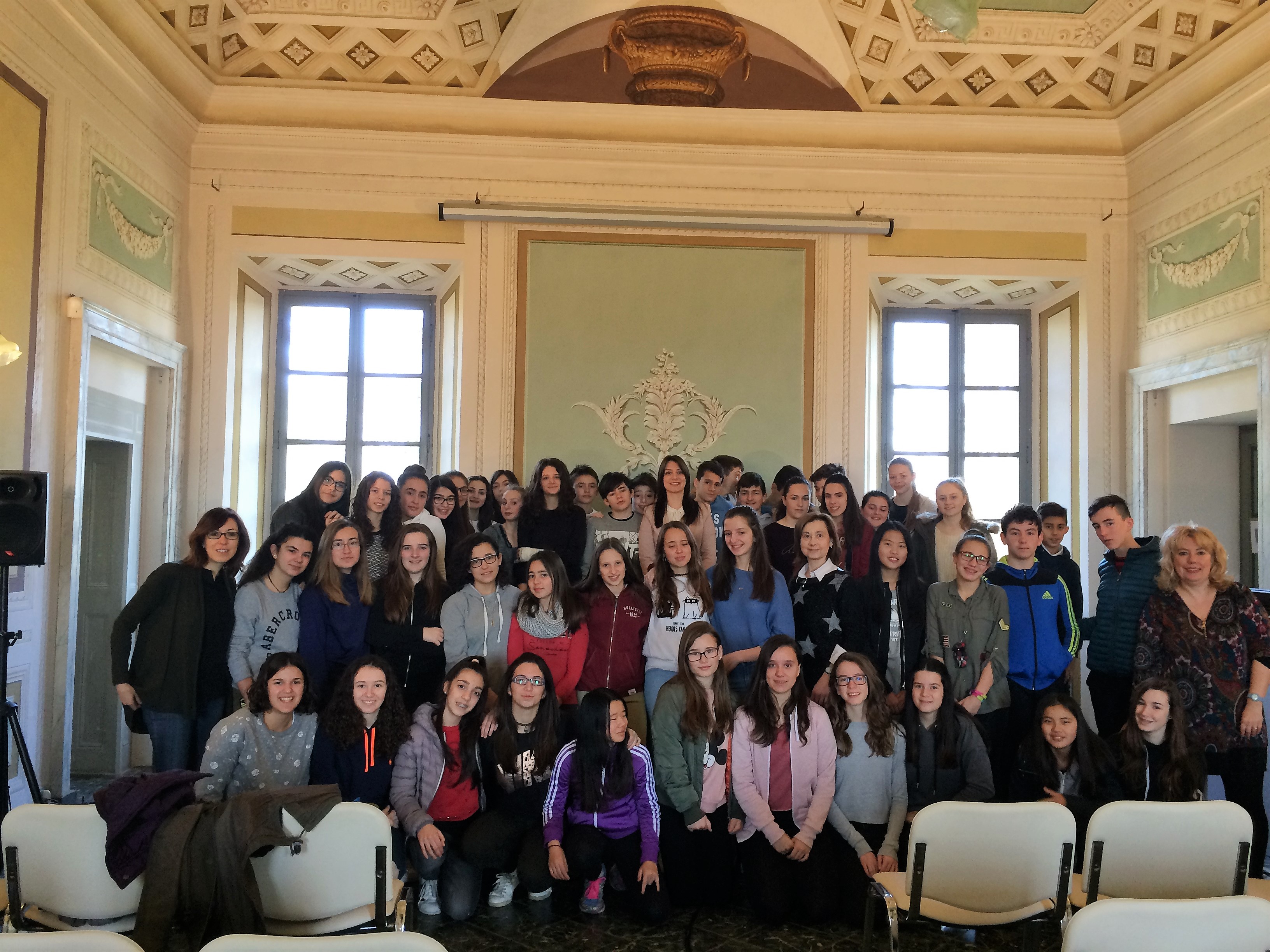
Gli studenti italiani e spagnoli che partecipano al programma Erasmus + hanno incontrato, il giorno 14 marzo 2017, lo scrittore Matteo Corradini presso il salone d’onore di Villa Braghieri.
Di seguito riportiamo l’intervista rilasciata dall’autore, in inglese, la lingua veicolare del progetto.
Q: When did you start to write?
A: When I was six years old, when I learnt to write. When I was twelve I began to write some novels about history. I studied Hebrew at university and I wrote some books about the Shoah. I was 34 when I became a writer.
Q: When you were a child, what was your favourite book?
A: It was “Treasure Island” by Stevenson, a fantastic adventure book. I can’t swim so my favourite book is about the sea. I love pirates and now I want to write a book about them.
Q: Which of your books is your favourite?
A: The next one.
Q: And your favourite writer?
A: I think it is better to read a book without knowing the writer. They are dangerous guys.
Q: How long does it take you to write a book?
A: It’s different for every book: some weeks or some years. I take a lot of time to prepare the story, the ideas for the book. Like a climber, I get ready for the climb for a long time and then I begin

Q: What about the work based on Anne Frank?
A: I was born to do it. It’s the work of my life.
Q: What gives you inspiration?
A: Everything in my life. Inspiration is an ordinary thing. I don’t know if inspiration exists. I believe in ideas and not in inspiration. You have to find and search for ideas. When I go around the street, for exemple, I take a lot of photos. I take ideas from reality: it is something so creative!
Q: What is the importance of reading, for you?
A: Today young people read a lot but not books. Reading is a journey, it’s an experience that can speak to your soul. It’s a very important experience that can make you know yourself without danger. Reading makes me free, social networks try to convince me about what I have to do. Reading is a personal experience of freedom.
Q: When you finish writing a book, what do you do?
A: I send it to some friends of mine that read it in a very short time. When they give me their “OK”, I send it to my publisher. Then I move on to another book and I forget about the old one.
Q: Tell us something about Anne Frank
A: When I started to study Anne Frank, I began to study her life. She wrote many diaries, personal diaries with colours and photos, not like books.

She wrote in Dutch, she went to a Dutch school. She was born in Germany but she escaped to Holland because of the racial laws. She had some friends in Holland, Dutch Jewish people and German Jewish people. She went to a Montessori school. Then, to escape the nazi persecution, with her family she hid in a secret place, near the building where her father worked. The diary was the only way to remain safe, to protect herself from fear, loneliness, pain. The responsability to publish this work was of her father. She read in Dutch, in German and French, she listened to the BBC radio in English: she was a European girl!
Anne Frank died in Bergen Belsen, in a concentration camp. The English army burned the camp and now nothing remains there, now you can only see trees and fields. There are fifty thousand people buried there, among them there is Anne Frank. Nothing in the place reminds us of the Shoah but we must see and remember with our minds and not only with our eyes: this is the real meaning of memory.
 La Voce dell'Olubra - Giornale online